Canibalismo
Legado en los huesosCanibalismo enters the investigation not as an abstract horror but as a material clue: a small piece of flesh, repeatedly frozen and thawed, that connects Berasategui to Johana Márquez. Its preservation turns an act of consumption into evidence, while the bite marks reveal how his fixation on Johana broke through the calculated control he ordinarily exercised over others.
The Preserved Piece
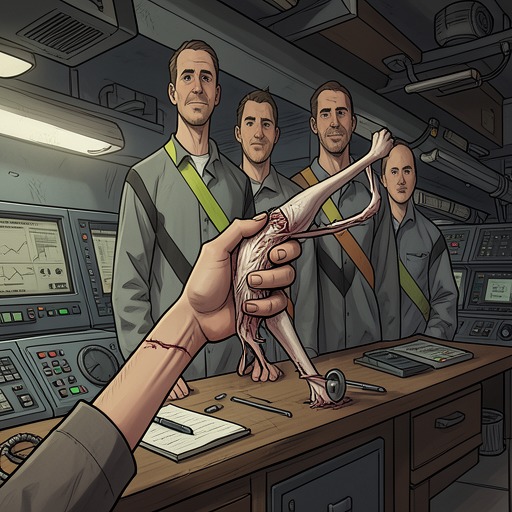
In the freezer, Amaia Salazar notices a small package whose loosened cord and repeatedly folded paper suggest it has been opened and closed more than once. Inside, transparent plastic covers a thin piece of flesh. Its fibers are frayed and whitish at the edges, consistent with repeated freezing and thawing. Amaia does not treat its identity as settled before laboratory analysis, but the visible bite marks give the object an immediate investigative significance: she judges that someone thawed it, bit off a piece, and froze it again. The flesh has been kept and consumed in turns, as though preservation and appetite were inseparable.
Jonan Etxaide likens the behavior to keeping a delicacy that cannot be resisted. That observation gives the package its double force: it is both a retained fragment and the trace of repeated eating. Its condition supplies a physical route from Berasategui’s hidden conduct to the investigation, rather than leaving the cannibalistic implication at the level of rumor or spectacle.
Johana Márquez and the Broken Pattern
The preserved flesh mattered because it pointed beyond the crimes’ visible resemblance to the person who had taken the missing arm. Jasón Medina admitted that he had strangled Johana Márquez and violated her body afterward, but he was baffled when questioned about the amputation. He had left the borda to fetch a rope, intending to imitate a different crime he had read about; when he returned, Johana’s arm was gone. The mutilation therefore did not fit the sequence of his impulsive violence, even though he was the killer.
That separation between murderer and trophy-taker sharpened the investigators’ question: if Johana’s murder had not been planned, how could the person who removed her arm have been present at precisely the right moment? The emerging explanation was that Doctor Berasategui had been following Medina. He had tried to influence Johana’s father, but Medina was too unpredictable to control; rather than directing the killing, Berasategui waited for the violence he expected and took advantage of its aftermath. The amputated arm was not simply another feature of Medina’s assault. Its removal joined a distinct, repeated pattern across cases.
Doctor Berasategui’s interest in Johana also marked a departure from his usual method. He was described as an inducer who worked through people willing to do what he wanted, not as someone who directly imposed his will. Johana became the exception: his desire to kill and consume her overcame the detachment and control that had protected his pattern. In the confrontation with Amaia Salazar, the investigator tied the small retained piece to a bite Doctor Berasategui had taken from Johana in the borda. Saliva on the flesh, she argued, connected the fragment to him despite the possibility that dental prostheses might otherwise complicate identification.
Cannibalism thus serves as more than a shocking detail. The fragment’s repeated thawing, biting, and refreezing makes appetite legible as a physical practice, while its careful retention exposes the fixation that disrupted Doctor Berasategui’s customary mode of operation. In the case’s logic, the decisive clue is not simply that flesh was consumed, but that this particular act was an excess: an obsession that left material evidence and made the hidden collector traceable.
The Limits of the Shared Signature
The cannibalistic clue sits within a broader pattern of postmortem arm removals, but the investigation distinguishes the act of consumption from the repeated mutilation that links cases. A forensic examination describes a clean cut made after death, with a toothed implement resembling an electric saw; the same general kind of cut had been noted in the case of Johana Márquez. Comparing photographs, Doctor San Martín found that the cuts appeared to follow the same technique and to have been made by a right-handed person with considerable confidence and comparable strength. Yet he could not establish from photographs alone whether the bones came from surgical amputations or grave desecrations, nor identify the tool conclusively. The missing physical samples limited what the resemblance could prove.
Other recurring details strengthened the investigators’ suspicion of a single operator without making every crime identical. In the Logroño case, the wife-murderer died by suicide in his cell after leaving the same unusual word on the wall that had been scratched into plaster with a toothbrush handle in another cell: “TARTTALO.” The shared wording and distinctive spelling, together with the removal of the same arm in cases otherwise marked by domestic violence, suggested a signature separate from the individual killers’ acts. Cannibalism gives that signature a more personal edge in Johana’s case: the fragment preserved in the freezer does not establish that every missing arm was consumed, but it connects one deliberate bite to the pattern of trophy-taking and helps expose the particular obsession behind it.
Appetite and the Limits of Control
The investigation’s account of Doctor Berasategui’s appetite also sets a limit on his apparent mastery. Amaia Salazar recognizes, while watching security footage with Padre Sarasola, that he goes willingly with Rosario. He may be skilled at steering violent people toward acts they are already inclined to commit, but that skill does not mean he commands everyone around him. His fixation on Johana Márquez has already exposed how desire can break his own discipline; beside Rosario’s purpose, his cannibalistic appetites seem smaller still.
Rosario’s objective reaches back to the birth of her identical daughters and has endured for more than thirty years without anyone diverting her from it. The contrast relocates the threat: Berasategui’s preserved morsel makes his private appetite tangible, but it does not make him the dominant force in the larger conflict. Cannibalism marks the point where his control falters, while Rosario’s long pursuit shows a will he cannot simply turn to his own ends.